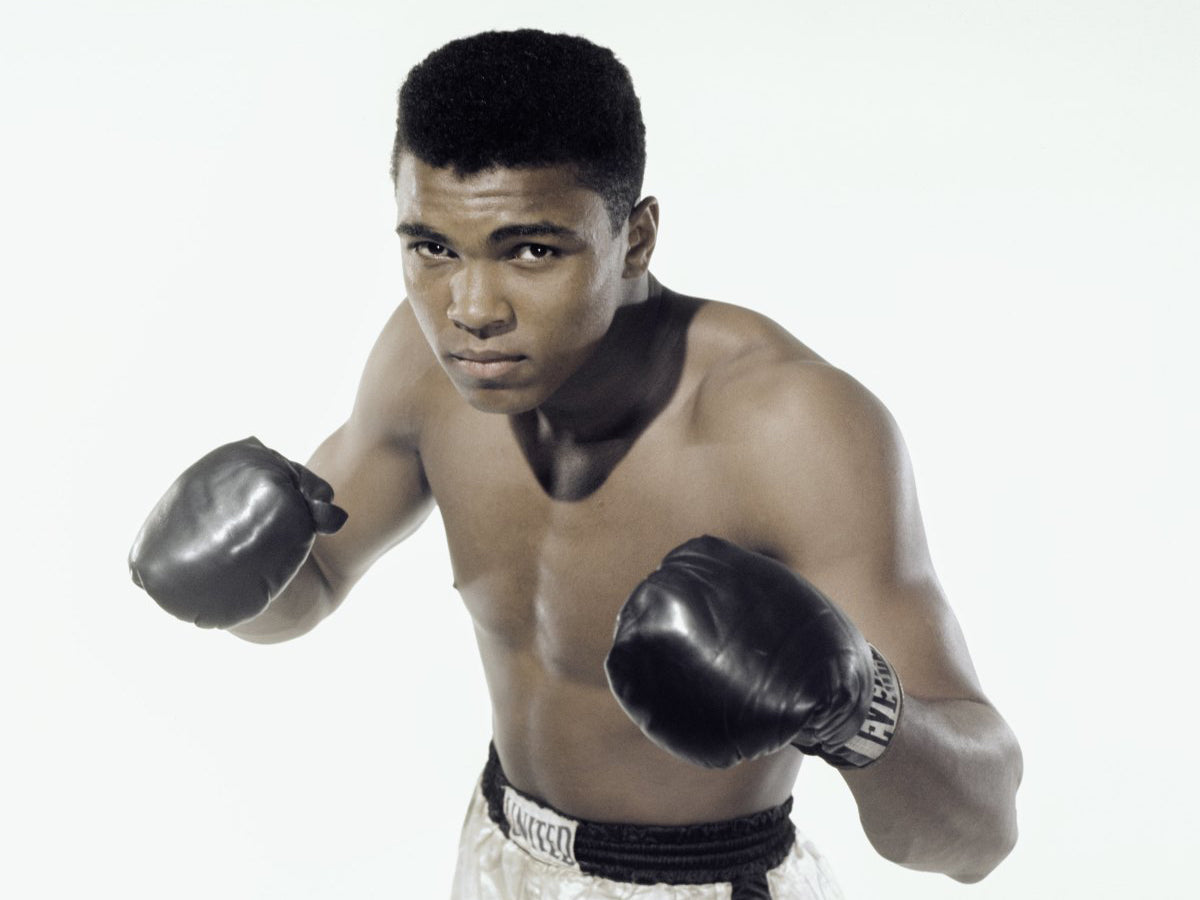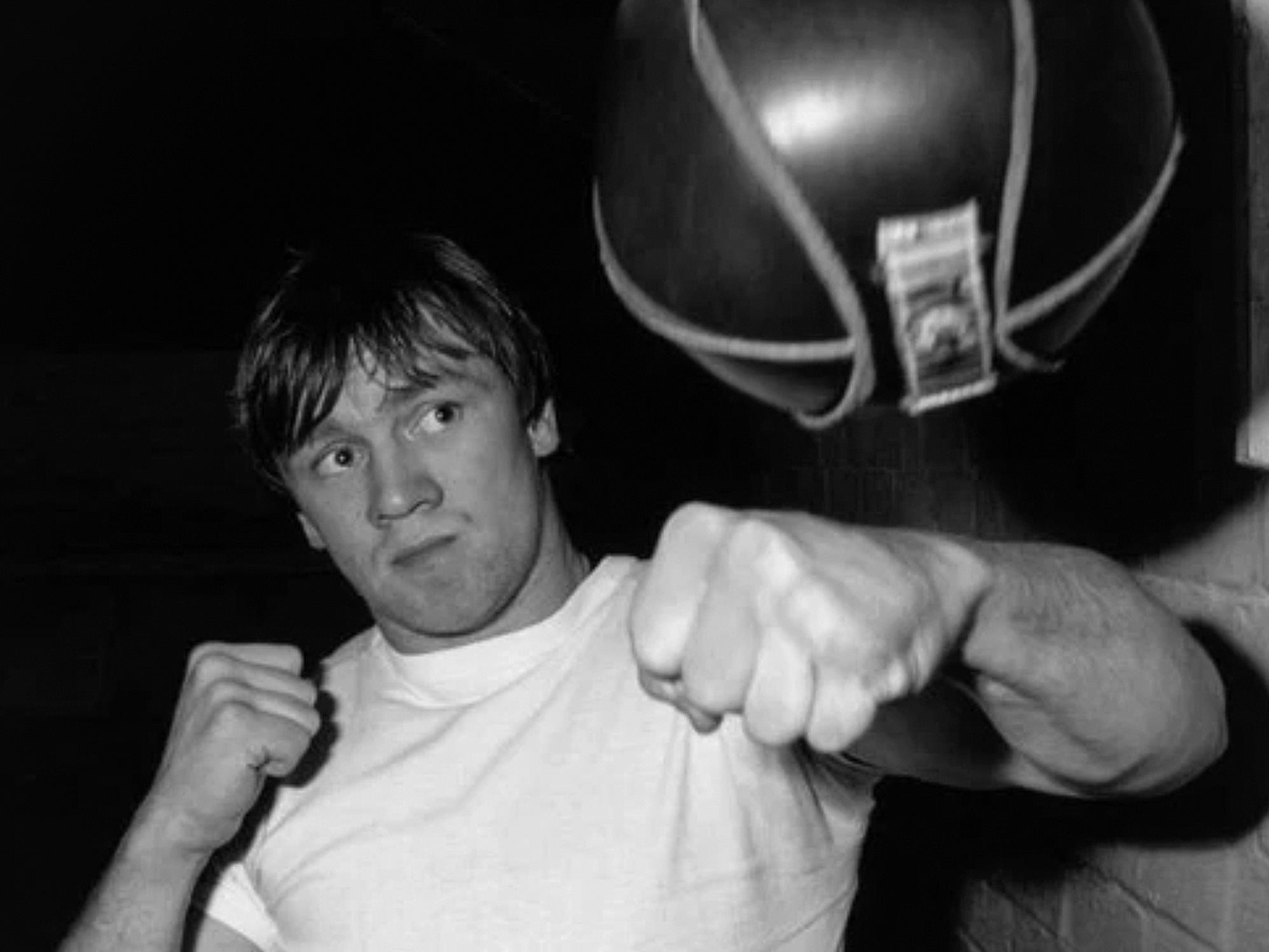



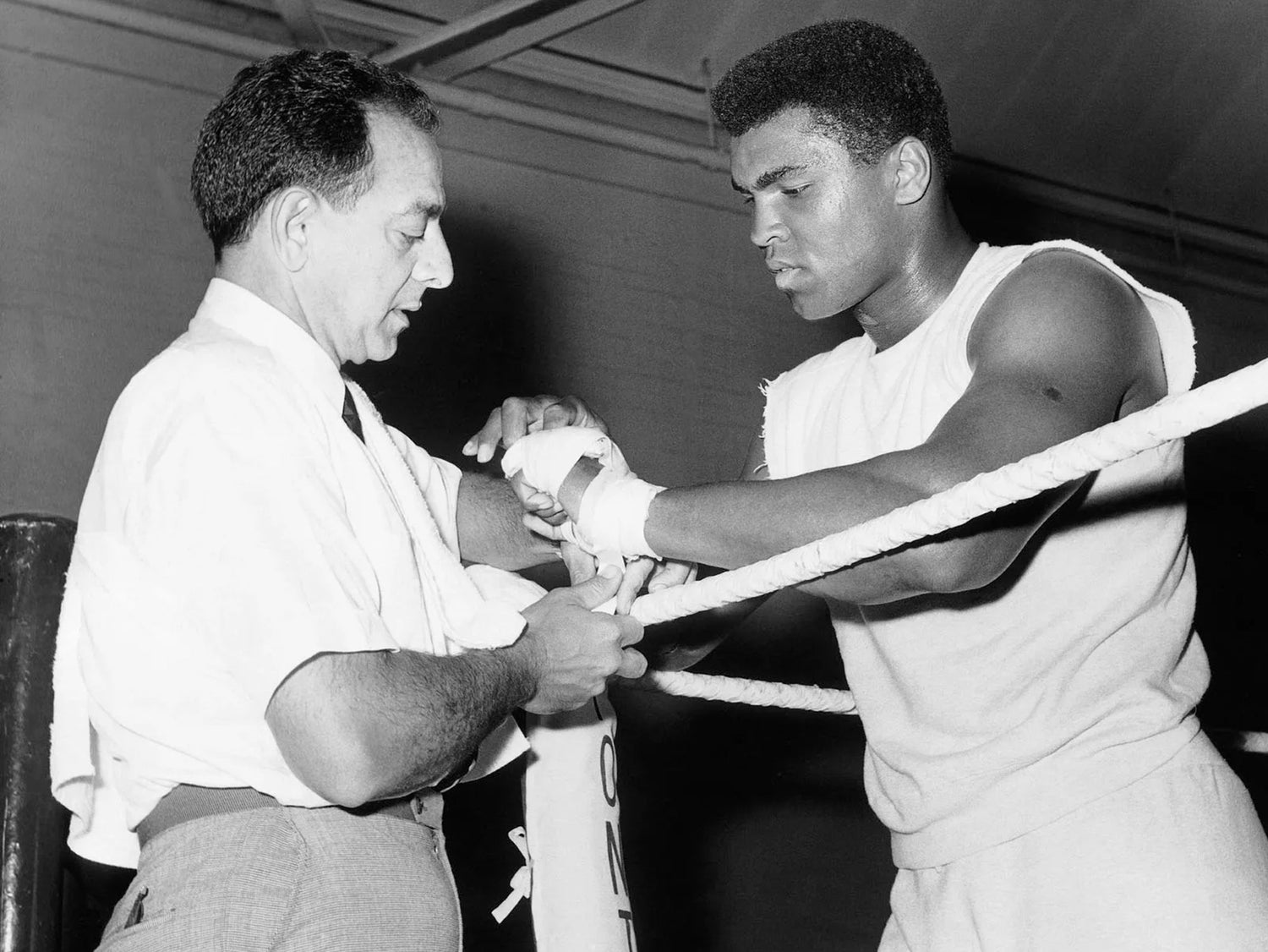
'BVB writer, Paul Zanon is currently working with prisoners at HMP Thameside using the power of sports writing to help them develop into wordsmiths. We are delighted to support his efforts by donating a prize to the winner of a competition he ran with the prisoners, which involved writing a biographical piece about Angelo Dundee. The winning entry is below.’
TRUE LEGEND
‘The most important prerequisite for a trainer is to know his subject. All fighters are different. No boxer ever fights entirely by the book.’
Angelo Dundee

As history teaches us, when a true legend is born, rarely does that driving force, who shapes and guides that legend in the making, ever gets highlighted in that narrative. However, the star-making genius, that blacksmith who forged The Greatest that is Cassius Clay, becomes that exception to the rule.
This extraordinary pragmatic visionary, who had talent for spotting diamonds in the rough, had a knack of knowing how to cut, craft and polish that raw talent like a supreme diamond setter. Albeit, Dundee may well have been the true jewel in the crown with his passion, skill and vision. That brilliant shining light of pugilistic excellence announced himself to the world as possibly the greatest ever. His passion and wisdom shone like a beacon of perfection reflected through his greatest ever prodigy, who we all got to know as Muhammad Ali.
Angelo Dundee was born in Philadelphia, USA on 30 August 1921 to Italian migrants and was one of seven siblings. His mother, Filomena Cianelli, was a stay at home mother, whilst his father toiled on the railways. Papa Dundee was born, Angelo Merenda, but he changed his name to Dundee after his fistic hero, world super featherweight champion, Johnny Dundee and from these humble beginnings the Dundee legacy began.
Dundee’s first taste of working the corners began whilst serving in the United States Air Force at their boxing tournaments, but it’s fair to say that the Pennsylvanian born native had no idea how far this experience would springboard him into his future role in the square ring. After leaving the military in 1945, he headed off to New York City where he was employed as a bucket boy at Stillman’s Gym, starting his apprenticeship for his future greatness. From NYC, Dundee relocated to Miami, Florida, joining his brother Chris, who was the founder and owner of the infamous Fifth Street Gym. This would become Angelo’s spiritual home for several decades to come, with a host of future superstars walking through the gym doors seeking tuition from the 5ft 6 inch master.
Despite most associating Dundee with Muhammad Ali, he was already moulding champions from as early as the mid 1950’s, the first of which was The Upstate Onion Farmer, Carmen Basilio. Despite Basilio being a self-confessed self-trained fighter, he would later discuss the merits of having Dundee as part of his team in the capacity of ‘cornerman,’ especially after winning the world welterweight crown against Tony DeMarco on 10 June 1955. Three fights and five months later, Basilio successfully defended his crown against DeMarco, in what was named as The Ring Magazine Fight of the Year for 1955. If that wasn’t enough, on 23 September 1957, Dundee cornered Basilio to victory against pound for pound great, Sugar Ray Robinson, making him a two-weight world champion as he took the world middleweight title.
 Angelo Dundee and Carmen Basilio
Bar two contests, Dundee was in Muhammad Ali’s corner for all his fights. The two fights in question were his pro debut on 29 October 1960 against Tunney Hunsacker and later in 1971, when Ali fought his friend and sparring partner, Jimmy Ellis, where ironically Dundee was in Ellis corner. Ellis was stopped by Ali in the twelfth stanza.
One of the most, if not Ali’s most memorable/controversial fights which boxing afficionados still discuss to this day, was Ali’s first encounter against ‘Our Enry’ on 18 June 1963 at Wembley Stadium. Cassius Clay as he was known then, was firmly put on the seat of his pants by Henry’s Hammer in the dying seconds of the fourth round and what happened in the next 60-70 seconds is still highly debated.
As Clay walked back to the corner, still dazed from the vicious left hook to his jaw, there were claims of Dundee cutting his charge’s glove and giving smelling salts on Clay’s return to the corner. This anecdote has become the foundation for many folklore tales over the years, but the fact is, Clay did have the luxury of a few seconds grace, which when you are dazed, are incredibly valuable. After the fight, Clay claimed his excuse for being knocked down was because, ‘I was looking at Liz Taylor at ringside.’

Another fight was famously referred to as The Rumble in the Jungle; a fight which many believed 32-year-old Ali could genuinely be killed by the 24-year-old destruction master, George Foreman. The fight took place on 30 October 1974 in Kinshasa, Zaire and despite being a huge underdog, Ali stopped Foreman in the eighth round to regain his world title. Foreman would later accuse Dundee of foul play for loosening the ring ropes, hence the ‘Rope-A-Dope’ saga, which still rumbles to this very day. The bottom line is that Ali had a strategy, albeit a very dangerous one which Dundee didn’t fully greenlight, but it worked.
Known for his powers of motivation, on 16 September 1981, Sugar Ray Leonard was in an absolute war with Thomas ‘The Hitman’ Hearns and in between the break of the twelfth and thirteenth rounds, Dundee shouted at Leonard, ‘You're blowing it now, son! You're blowing it. We need fire and you're not firing! You're blowing it. Ray, you've got to be quicker! You've gotta take it away from him!’ Leonard duly stopped Hearns in the fourteenth round.
 Angelo Dundee and Sugar Ray Leonard
There’s a temptation to list Ali’s career when discussing Dundee’s merits, but that would be a travesty if we didn’t list some of the other world champions he trained such as Willie Pastrano, Jose Napoles, Luis Rodriguez, Ralph Dupas, Sugar Ramos, Pinklon Thomas, Wilfredo Gomez, Michael Nunn and Trevor Berbick. In addition, he trained a long list of world title hopefulls, such as James ‘Quick’ Tillis, Sean Mannion, Troy Darrell and David Estrada, to name a few.
In total, Dundee trained an epic 16 world champions, not to mention cornering countless world level contenders. It would have been an absolute injustice if Angelo had not been recognised and honoured for his sheer brilliance, which thankfully he was in 1992, when he was inducted into the International Boxing Hall of Fame in 2009, under the trainers and managers category. Other notable plaudits include receiving the Boxing Writers Association of America Al Buck Award for Manager of the Year in both 1968 and 1979, the Boxing Writers Association of America James J. Walker Award for Long and Meritorious Service in 1996 and let’s not forget his initial induction into the International Boxing Hall of Fame in 1992 under the Non-Participant category.

On 1 February 2012, the global boxing community mourned the passing of the mere mortal, supreme diamond setter, Angelo Dundee, with a plethora of some of the world’s greatest boxing figures paying their final respects, such as Bob Arum, Muhammad Ali, Antonio Tarver and Howard Bingham (Ali’s photographer). It’s fair to say he was loved and sadly missed. He left this world with great commentaries and footage of his legacy, demonstrating how he elevated mortals to champion legendary status. Angelo Dundee, above all, led them to inside and outside the ropes and as he left us on earth, he continues to make history beyond the pearly gates of heaven, which will ensure his legendary status of pure genius will never be forgotten. A true legend. To paraphrase the words of Julius Caesar, ‘He came, he saw, he conquered.’