


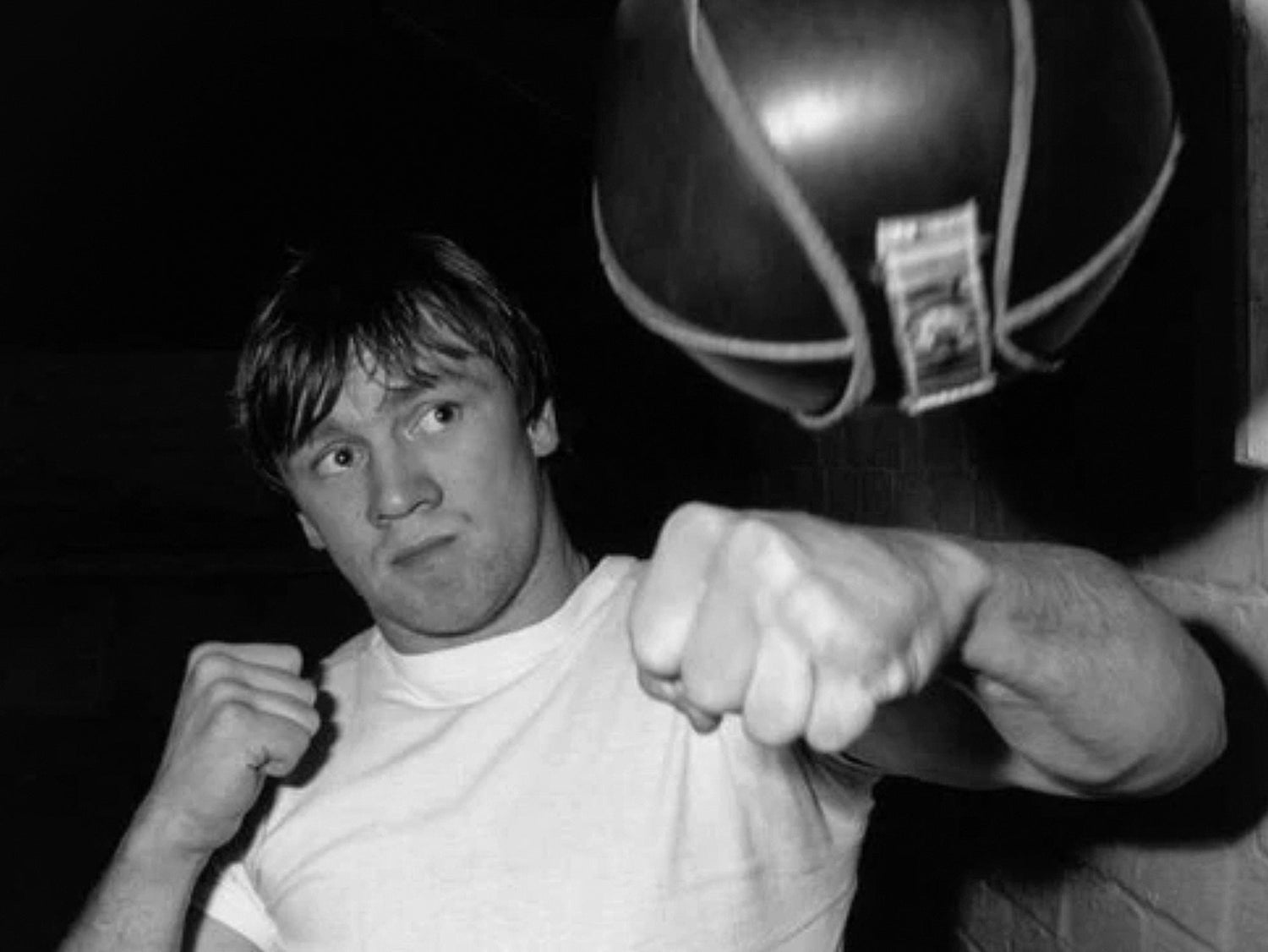
'To me it's the darkest game in the world. It really is dark, and you've got few friends or none at all.’ Tony Sibson

Tony Sibson is one of the least talked about middleweight British greats from a very competitive bygone era which is strange, because he won the British, Commonwealth and European straps, not to mention being a three-time, two weight world title challenger. Let’s delve into Sibbo’s fighting life and share just how tough Leicester’s favourite fighting son was.
Born in Braunstone on 9 April 1958, Sibson was of Romany gypsy heritage and rumour has it that anecdotes of his relative Wally Sibson, who fought in the 1920’s amassing a career of 19 victories in 30 contests, was an inspiration as to why young Tony decided to step through the ropes and into the square ring.
Whilst learning his craft in boxing, Sibson worked a number of tough jobs from his early teens, such as being a hod carrier and working in a slaughterhouse, which no doubt helped progress his physical stature and improve his resilience. At the same time, he was cutting his teeth at Belgrave ABC in Leicester, under the watchful eyes of his coach, Jim Knight. Despite amassing a very respectable record of 82 victories in 102 amateur outings, Sibbo never really excelled at this level, hovering around regional/national exposure, with no silverware of note. He did however, represent England at the 1975 Amateur Boxing Association (ABA’s), but perhaps the main reason he never excelled was down to his aggressive, come forward pressure fighting style, which would soon be appreciated in the professional ranks.
Weighing in at 158lbs, Sibson had his pro debut on his eighteenth birthday (9 April 1976), stopping Merseyside boxer, Charlie Richardson early doors at Digbeth Civic Hall, Birmingham.

By 23 May 1978, Sibson had been fighting a little over two years and was undefeated in 25 contests – that was until he came up against Zambian Lottie Mwale, a natural light heavyweight who was only 6-0 since turning pro in April 1977. Despite the contest being billed as a middleweight fight, Mwale was almost bang on the modern day super middleweight limit of 168lbs, while Sibbo gave away 4lbs and several inches of reach and height to the future light heavyweight Commonwealth champion. Sadly, for the Leicester man, he was knocked out cold in the opening round by the 1974 Commonwealth Games gold medallist.
Not one to stand around and lick his wounds, Sibson fought a further five times before the end of the year, winning four and losing one to Jamaican born Londoner, Eddie Smith, on points. Sibson started 1979 with gusto, avenging his loss to Eddie Smith with a points victory of his own on 5 March, then one month later took on Frank Lucas at the Royal Albert Hall for British middleweight title, which had recently been vacated by Alan Minter. A fired up Sibbo stopped Lucas in five of the scheduled 15 rounds and in doing so, won his first professional belt.
Despite clocking up three knockout victories on the bounce over the next five months, Sibson lost his British strap to teak tough Kevin Finnegan on 6 November, by a razor fine points decision. With plenty of gas still in the tank, Sibbo knocked out Robert Powell three weeks later in the first round.
Two fights later, on 4 March 1980, Sibson beat Zambian born Chisanda Mutti on points at the Empire Pool, Wembley, to be crowned the new Commonwealth middleweight champion. With, two back-to-back victories straight after, the Leicester favourite now had his sights set on greater things before the end of the calendar year. On 8 December 1980, Sibson took on the reigning Italian and European middleweight champion, Matteo Salvemini at the Royal Albert Hall, stopping the unbeaten Italian in seven rounds. Salvemini had beaten Finnegan on points to become European champion, so, in a way, there was an avengement, or a statement of sorts by stopping the man who put a notable blemish on his record.
1981 proved to be a breakthrough year for Sibson, which propelled him up the world rankings. From January to November he fought five times and won five times, which included three defences of his European crown - namely a unanimous points victory over Spaniard Andoni Amana, in his backyard of Bilbao, followed by a three round demolition of the recently dethroned world champion Alan Minter at the Wembley Arena and finally, a tenth round stoppage over Italian middleweight champion, Nicola Cirelli (24-1 at the time), also at Wembley.
 Tony Sibson vs Alan Minter
Sibson’s first fight of 1982 was against Detroit resident, Dwight Davison, who stood over five inches taller than Sibbo and had only lost once in his 32 outings as a pro, which included notable wins against the likes of Wilford Scypion and Sugar Ray Seales. The fight was officially a final eliminator for the WBC world middleweight title and despite the reach advantage, Sibson closed his man down and won a comfortable points victory on all three scorecards.
While Tony waited for the matchmakers to arrange the Marvelous Marvin Hagler fight for the world title, Sibson racked up another two victories including another defence of his European title, which he vacated towards the end of 1982. The new European champ would be Frenchman, Louis Acaries, who Sibson would cross paths with a couple of years’ down the line.
On 11 February 1983, Tony Sibson dared to be great and took on arguably the best middleweight of all time in Marvin Hagler. After five gruelling rounds in Massachusetts, the referee brought a halt to the proceedings in the sixth, officially declaring Hagler the victor by TKO. Sibbo’s journey was far from over.
 Tony Sibson vs Marvin Hagler
Four fights later, now boasting a record of 49 victories, five losses and one draw, on 25 February 1984, Sibson took on Louis Acaries in his backyard of Paris, in an attempt to regain his European middleweight title. After 12 gritty rounds, and despite the home advantage, Sibbo ground out a well-deserved points victory to be crowned a two-time European champion.
Nine months later, on 27 November 1984, Sibson put his European strap on the line as he took on the reigning British and Commonwealth middleweight champion, Mark Kaylor, for a winner takes all contest at the Wembley Arena. Despite a very game and gutsy performance from Kaylor, all three judges had Sibson two rounds ahead at the final bell.
 Mark Kaylor and Tony Sibson
Three victories later, which included a defence of his Commonwealth strap, on 10 September 1986, Sibson moved up to light heavyweight to Challenge Kronk powerhouse, Dennis Andries, for the British and WBC world light heavyweight titles at the Alexandra Pavillion, London. Sibson struggled to make a dent on Andries and after being knocked down three times in the ninth round, the contest was brought to a halt.
On 16 September 1987, Sibson stopped Sheffield fighter, Brian Anderson in the seventh round, to retain his British and Commonwealth straps and in doing so, won the prestigious Lonsdale belt outright.
On 7 February 1988, Sibson had one last roll of the dice and took on unbeaten and reigning IBF middleweight champion, Frank Tate. Despite a spirited effort, Sibson was knocked out in the tenth round by the American and Sibbo retired soon after at the age of only 29. Despite numerous offers at a number of different weights, he remained retired and boasted a very respectable record of 55 wins (31 by stoppage), seven defeats (including three world title challenges), and one draw.
Sibson’s come forward style and one punch knockout power made him a fan favourite and although he didn’t possess an array of Olympic medals or amateur honours, as a professional, he was the best in Europe and in a different era may well have been a world champion. Losses against the like of Hagler and Andries are more than respectable. In conclusion, I think it’s fair to say that Sibson is one of Britian’s least talked about middleweight greats, partly because he wanted it that way. Retiring at 29 he chose to live a quiet life in Leicester and drifted off into the fistic sunset. In a day and age where many sportspeople are looking for self-gratification, that shows the humility of the man with the heart of a lion.
Paul Zanon, has had 11 books published, with almost all of them reaching the No1 Bestselling spot in their respective categories on Amazon. He has co-hosted boxing shows on Talk Sport, been a pundit on London Live, Boxnation and has contributed to a number of boxing publications, including, Boxing Monthly, The Ring, Daily Sport, Boxing News, Boxing Social, amongst other publications.