


"Shakespeare? Never heard of him. Is he one of those foreign heavies? I'd moider dat bum." Tony Galento

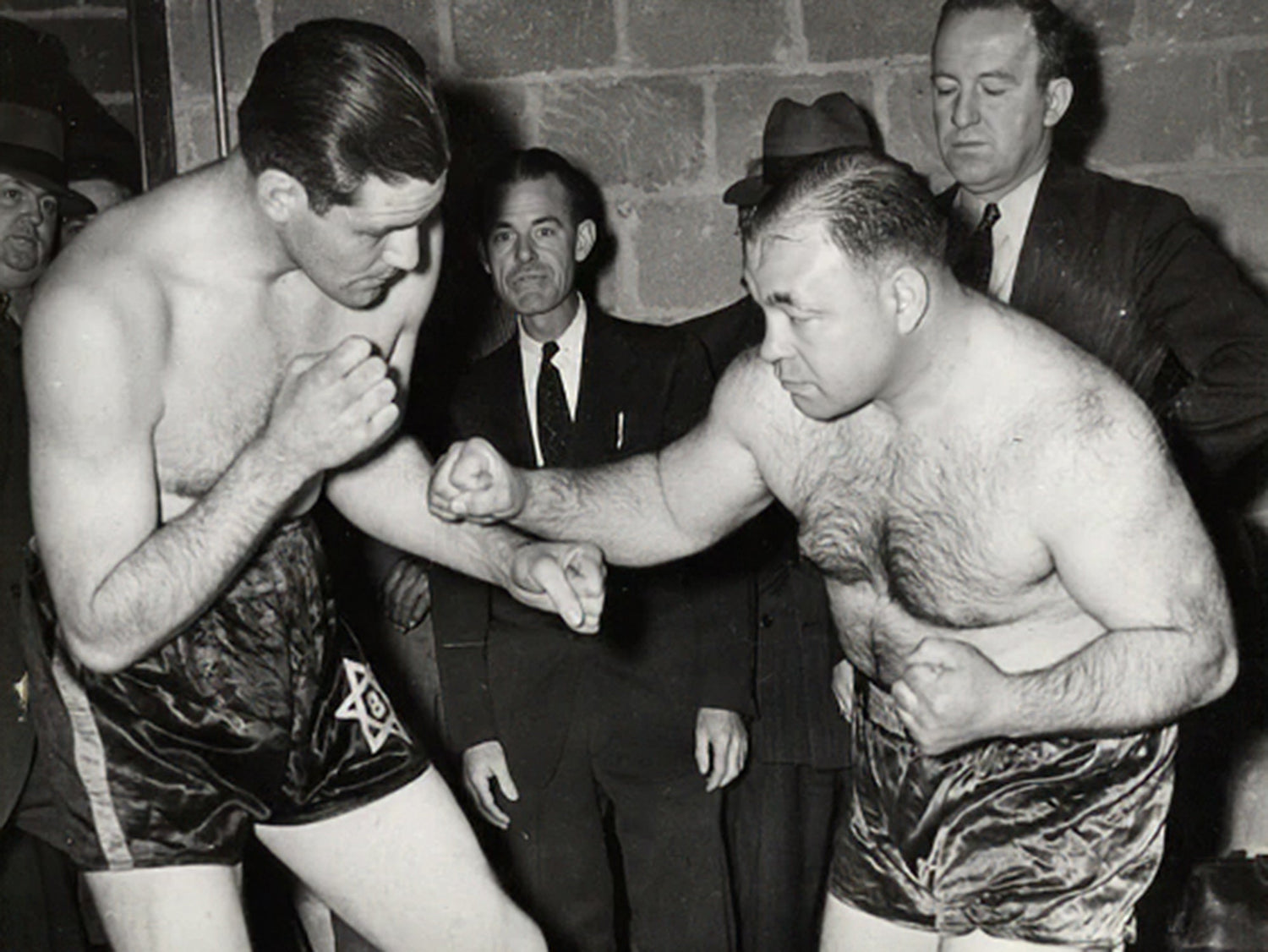
Dominic Anthony Galento, was possibly one of the grittiest and most colourful characters of a bygone boxing era. The man who claimed he trained on beer, burgers and spaghetti, stood at 5 ft 9 inches and averaged near 240lbs during his career; which for the records, was 112 fights, fearlessly taking on some of the best of his heavyweight generation. His reach was short, his speed was slow and his style was somewhat unorthodox. He would leap from a crouch, could take a punch and could certainly knock opponents out with his own arsenal. Let’s delve into the fabric of his journey and some of those contests.
Hailing from Napolitan roots, Southern Italy, after initially working as a quarry worker, Galento’s father found a job at the Edison factory in Orange, New Jersey and firmly planted the family’s roots there. Born on 12 March 1910, Galento grew up in an Irish neighbourhood and soon earned a reputation for being a decent street fighter and bad academic. A hard worker from the get-go, Two Ton took on a number of jobs, including working in an ice factory and also dabbled in selling liquor during the Great Depression. As for his moniker, it is believed this was derived (a few years later), not from his ample waistline, but after arriving late to one of his fights. His manager shouted at him and Galento replied, ‘Take it easy. I had two tons of ice to deliver on my way here.’

By the age of 16, a friend encouraged the tearaway to visit the local boxing gym at the Orange YMCA, which saw him going on to clock up an amateur record of 28-3, then on the day of his eighteenth birthday, on 12 March 1928 against West Virginian born, Floyd Shimalla, Tony had his pro debut. Stopping his foe in the third round, the pair met once again five weeks later, with Galento repeating the result with a fourth-round stoppage.
Three weeks later, Galento, weighing around super middleweight at the time, fought Johnny Alberts, losing every one of the eight rounds on points. However, there’s a side story that accompanies Galento’s first loss. Alberts fought under the name of Heinie Summers and was far more experienced than he had let on. Undeterred by the contest, Galento finished 1928 with a record of six wins, two losses, one by disqualification, due to head butting his opponent, which would be representative of his rough-house tactics throughout his career.
Galento soon started to gain a reputation as an outspoken individual, making him a dream for any media who he crossed paths with. He would have fared very well in today’s climate of heated press conferences and most likely would have earned a lot more money with his braggadocio personality.
By the end of 1938, in his first 10 years in professional boxing, Galento had amassed a record of 70 victories, 23 losses and six draws, taking on some great opponents (not in boxing calibre, but in names), such as Patsy Perroni, Battling Bozo, Italian Jack Herman and Unknown Winston. On 11 April 1932, Galento fought Arthur De Kuh at the Laurel Garden, Newark after eating 52 hot dogs in the preceding hours, after taking on a $10 bet that he couldn’t eat 50 hot dogs and still fight his opponent. In addition to surpassing the stated number and barely being able to fit into his trunks, he disposed of 6ft 4 inches De Kuh in four rounds. Similar anecdotes exist for a number of Tony’s fights. Let’s just say his training regime was enigmatic, as he lived off a staple diet of junk food, alcohol and cigars, not to mention, he wasn’t a lover of roadwork.
1939 turned out to be a year that gained him the respect of the boxing fraternity and at one point looked like he might even gain the world heavyweight boxing strap. Coming off a 10-fight winning streak, all by knockout, which had earned him the No.1 contender spot, on 28 June, Galento took on the Brown Bomber, Joe Louis at Yankee Stadium, The Bronx, New York. In the leadup to the fight, Galento stated, ‘They are here to see me moider this bum.’ Galento claimed he would ‘moider,’ most of his opponents, but was more often than not claiming, ‘I could moider a burger.’ With a three inch height differential and 33lbs separating the pair (Louis weighing in a fraction over 200lbs), there was a stark difference in body shapes. However, for Galento, his weight equated power behind his punches and that formula almost toppled the champ.

First round, Tony came out like a stampeding rhino and staggered the Alabama all-time great with a number of left hooks, who boasted a record of 38-1 at this point. Round two, Galento was dropped with a straight right towards the end of the round, but it was round three which lit up 34,852 onlookers at Yankee Stadium as Tony knocked down Louis with a cracking left hook. Unfortunately for Galento, now with a reddened face and blooded nose, Louis repaid the favour with interest in the fourth round, bringing the contest to a halt with a little over 30 seconds left in the round. All was not lost though, as Galento’s stock rose and he was targeted as a good scalp for world title contenders to beat, not to mention, he would be dining off that third round for many years to come.

Galento’s unconventional style was not appreciated by all. On 15 September 1939, Galento locked horns with Lou Nova, who had only suffered one loss in 27 contests and possessed a decent knockout ratio. Scheduled for 15 rounds at the Municipal Stadium, Philadelphia, the contest was stopped in the fourteenth as Tony was declared victor by TKO. Those at ringside were very vocal about the outcome, and The Ring Magazine wrote: ‘…...One of the most disgraceful fights staged since the days of the barroom brawls. Referee George Blake would have retained his reputation as a great referee had he disqualified Galento.’ The reference was towards Galento’s constant use of thumbing Nova's right eye until it was in an awful state. Galento was quoted as saying, ‘I don't see anything wrong in sticking your thumb into a guy's eye. Just a little.’
The media had now started to cook up Galento’s form, claiming he had not only beaten Duva, but caused more harm and problems to a long list of Louis’ sturdy opponents, such as Primo Carnera and Max Baer. It was the latter who took offense and on 2 July 1941, Galento and Baer fought at Rosevelt Stadium, New Jersey.
According to the bookies, Baer went into the fight as the underdog , albeit, many called the contest, ‘The Battle of the Bums.’ After a number of heated exchanges at various press conferences, Baer beat up Galento to the point he was unable to answer the bell for the eighth round. Nine months later, Max’s brother, Buddy, repeated the feat, also disposing of Tony in seven rounds.

Galento vs Baer 1941
Between 1943-44, Galento fought his last three contests, winning all by stoppage. His record during his 15-year career was: 79 victories (57 by KO), 26 losses, six draws and one, no contest. The lure of the ring drew him back in 1948, but this time in the guise of professional wrestling. Notable opponents included The Ambling Alp, Primo Carnera (who went on to become the only fighter to be crowned world heavyweight champion in both boxing and wrestling disciplines), a 550lbs bear in a cage, a giant octopus in a tank and a kangaroo.
In retirement, Galento spent a lot of time investing his time into philanthropic causes dear to his heart, was involved in a number of business ventures, dabbled as a boxing referee and also appeared on the big screen and on stage for a number of well known productions such as, Guys and Dolls, On the Waterfront and Wind Across the Everglades.

Galento inevitably had his battles outside of the square ring, including charges for gambling, disorderly conduct and assault, to mention a few, which all added to his melting pot of life, but he also earned recognition from the boxing community, being inducted into the New Jersey Boxing Hall of Fame in 1970. By his mid 60’s Galento’s health deteriorated, mainly due to diabetes. He had his left leg amputated in 1977 and his right one in 1979. A week later, he died on 22 July 1979 from a heart attack at the age of 69 at St Barnabas Hospital. Galento was buried on the same site he was married in 1935 in New Jersey and the funeral mass was attended by a host of big boxing names, includes former heavyweight champ, Jersey Joe Walcott.
Boxer, businessman, brawler and entertainer. He was more about the sweet tooth than the sweet science, but Galento became a fighter ingrained in boxing folklore for many generations to come. They don’t make em like Two Ton Tony Galento anymore.
Paul Zanon, has had 11 books published, with almost all of them reaching the No1 Bestselling spot in their respective categories on Amazon. He has co-hosted boxing shows on Talk Sport, been a pundit on London Live, Boxnation and has contributed to a number of boxing publications, including, Boxing Monthly, The Ring, Daily Sport, Boxing News, Boxing Social, amongst other publications.